


 Français
 Tunisie
When people ask, “what is the main goal of open source software,” the most common answer usually revolves around cost-free access. That is an oversimplified view. The open source movement, as it has evolved since the late 1990s, carries a far more ambitious mission: to guarantee every individual, organization, or government the right to access, understand, modify, and redistribute the software code powering their digital tools.
This fundamental right has direct consequences for innovation, security, digital sovereignty, and equal access to technology. In 2026, while more than 90% of enterprise codebases include open source components according to Synopsys analyses, understanding the real objectives of this model has become essential for every digital professional. The following sections explore each dimension of this core objective and its practical implications.
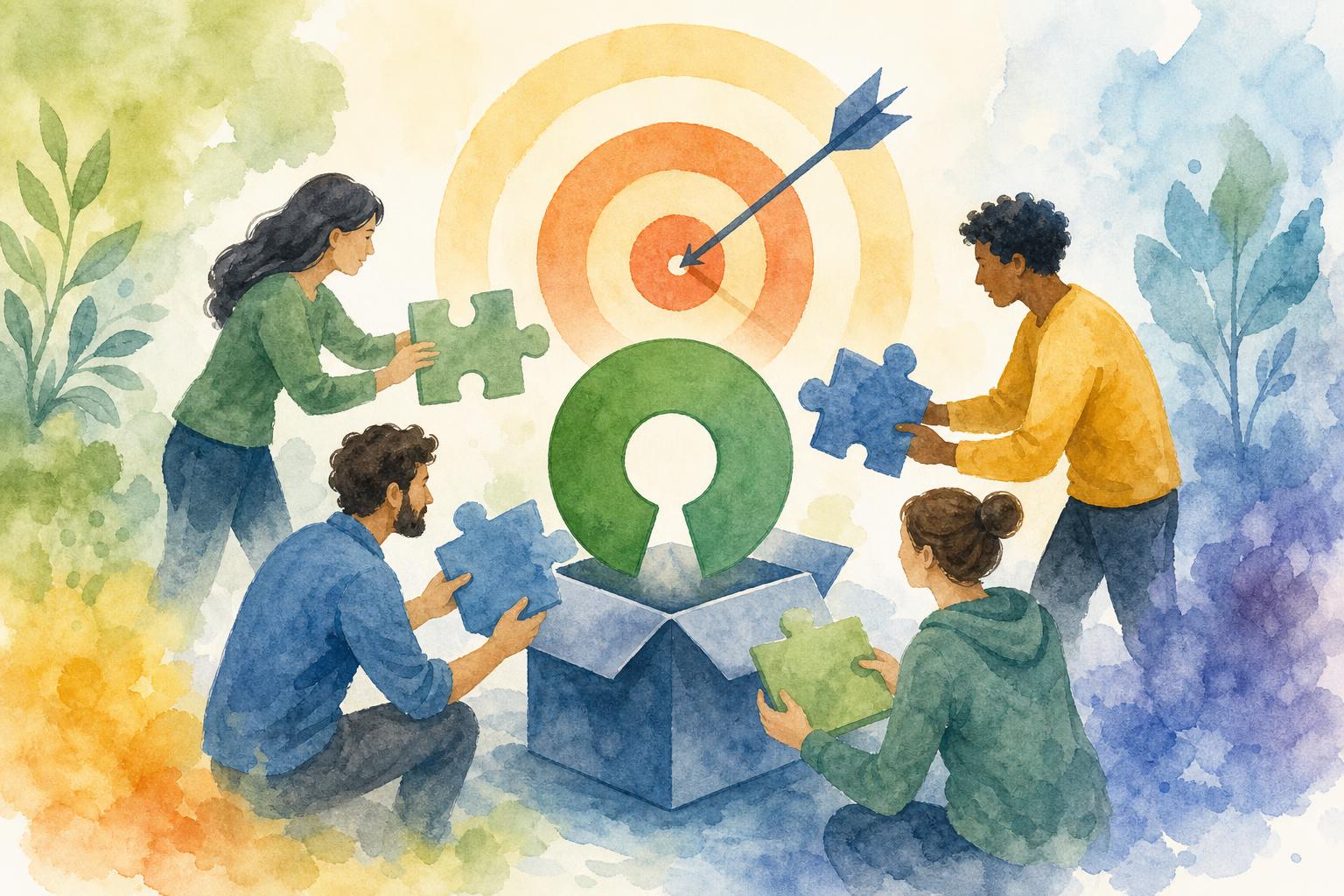
Democratizing Access to Technology
The primary objective of Open Source software is based on a simple principle: technology should not be a privilege reserved for those who can afford expensive software licenses. This belief inspired the creation of the Free Software Foundation (FSF) by Richard Stallman in 1985, followed by the formal introduction of the term “open source” by the Open Source Initiative in 1998.
Since then, thousands of projects have turned this ambition into reality by providing professional-grade tools accessible to everyone, from independent developers in Nairobi to research laboratories in Toulouse.
Eliminating Financial Barriers and Licensing Constraints
Software licensing costs represent a significant expense for businesses and public institutions. In 2026, a Microsoft 365 E3 license costs approximately €36 per user per month. For a regional administration with 500 employees, that amounts to €216,000 annually. Alternatives such as LibreOffice, Nextcloud, or Thunderbird cover a substantial portion of these functional requirements without licensing fees.
This perfectly illustrates the main difference between Open Source and proprietary software: open source solutions can be used, modified, and redistributed freely, without dependence on restrictive licensing models imposed by a single vendor.
The absence of licensing fees does not mean there are no costs. Deployment, maintenance, and training still require investment. However, the cost structure changes fundamentally: money is redirected toward local expertise, integrators, trainers, contributors, rather than foreign software publishers.
The French National Gendarmerie, which migrated 72,000 workstations to Ubuntu and LibreOffice, documented savings of several million euros over a decade while simultaneously building valuable internal expertise.
Freedom to Use, Modify, and Distribute
The four freedoms defined by the FSF form the legal basis of the model: the freedom to run the program for any purpose, to study how it works, to redistribute copies, and to distribute modified versions. These freedoms are guaranteed by licences such as the GPL v3, the Apache 2.0 Licence and the MIT Licence, each with specific restrictions on redistribution.
This freedom to modify software has direct practical implications. A hospital can adapt a patient record management system to its own internal procedures. A startup can build a commercial product on top of PostgreSQL without negotiating licensing contracts. A teacher in Senegal can distribute copies of GeoGebra to students legally and freely.
An open source license transforms software from a locked commercial product into a shared digital commons.
Collaborative Innovation at the Core of Development
The open source model does more than make technology accessible: it fundamentally changes how software is designed and improved. Distributed collaborative development, enabled by platforms like GitHub and GitLab, allows thousands of contributors to work simultaneously on the same project regardless of employer or geographic location.
The Role of the Global Developer Community
The Linux kernel demonstrates this dynamic better than any other project. In 2025, more than 15,000 developers from over 1,400 companies contributed to the kernel. Engineers from Google, Red Hat, Intel, Huawei, and hundreds of SMEs work side by side on the same code repository.
This diversity of contributors brings a wide range of perspectives, use cases, and expertise that no single organization, regardless of size, could gather internally.
Project governance relies heavily on peer review mechanisms. Every proposed modification, commonly known as a pull request, is reviewed by other developers before integration. While this process can sometimes appear slow, it ensures a high level of software quality.
Organizations such as the Linux Foundation, the Apache Software Foundation, and the Eclipse Foundation provide the legal and organizational frameworks necessary for collaboration at global scale.
Accelerating the Software Improvement Cycle
Proprietary vendors typically release major updates every 12 to 24 months. Active open source projects operate on much shorter cycles. Kubernetes releases three minor versions annually. The Firefox browser follows a four-week release cycle.
This rapid pace enables faster integration of user feedback and quicker security fixes.
Network effects also play a crucial role. When one company fixes a bug in an open source component it uses, that fix benefits every other user of the component. Every individual contribution creates collective value.
This mechanism explains why companies like Meta invest heavily in projects such as React and PyTorch: they benefit in return from improvements made by thousands of external contributors.
Transparency and Security Through Open Code
One of the strongest arguments in favor of free software concerns security. The principle is summarized by Linus’s Law: “given enough eyeballs, all bugs are shallow.”
Access to source code allows any expert to verify what a program actually does, a possibility structurally absent in proprietary software.
Auditability and Rapid Vulnerability Detection
The Log4Shell vulnerability (CVE-2021-44228) demonstrated both the strengths and weaknesses of this model.
The flaw, found in the Apache Log4j library used by millions of applications, was identified and fixed within days thanks to community mobilization. A patch was released in less than 72 hours.
In a proprietary environment, users would have had to wait for the vendor’s response without any possibility to inspect or fix the issue themselves.
Programs such as the OpenSSF, launched under the Linux Foundation, fund systematic audits of critical software components. In 2026, the Alpha-Omega initiative specifically targets the most widely used dependencies in software supply chains.
In France, ANSSI explicitly recommends the use of open-code software for sensitive systems precisely because independent audits are possible.
Digital Sovereignty and Data Control
Digital sovereignty has become a major issue in Europe since the enforcement of the GDPR and debates surrounding the American Cloud Act.
Proprietary software, often produced by companies subject to foreign jurisdictions, creates trust issues because users cannot verify whether hidden backdoors exist in the code.
Free software provides a structural response to this concern.
The French government established priority for free software in the Ayrault Circular of 2012, later reinforced by the DINUM. The SILL (Interministerial Free Software Base) lists recommended solutions for public administrations.
European initiatives such as Gaia-X also integrate open source components to build sovereign cloud infrastructures.
Complete control over deployed code ensures that citizens’ data does not pass through opaque systems.
Interoperability and Long-Term Sustainability
A frequently underestimated objective of open source software concerns interoperability between systems and the long-term sustainability of data formats.
Open standards and documented protocols ensure that data remains usable independently of the original software vendor.
Adoption of Universal Open Standards
Formats such as ODF (Open Document Format), protocols like SMTP and HTTP/2, and specifications like OpenAPI emerged or flourished thanks to the open source ecosystem.
These standards allow different software applications to communicate without relying on proprietary formats.
A practical example: an organization storing documents in ODF format can open them using LibreOffice, OnlyOffice, Collabora Online, or any compatible editor. If documents are stored exclusively in DOCX format, the organization remains dependent on backward compatibility decisions made by Microsoft.
This technical distinction has major legal and archival implications, particularly for preserving administrative documents over decades.
Independence from Proprietary Vendors
Vendor lock-in is recognized as a strategic risk by IT departments worldwide. When an organization depends on a single vendor for a critical function, it becomes vulnerable to price increases, roadmap decisions, and product discontinuation.
Open source reduces this risk structurally: if a project is abandoned by its main maintainer, the community can continue it through a fork.
The case of MariaDB, created as a fork of MySQL after its acquisition by Oracle, perfectly illustrates this mechanism.
Users concerned about Oracle’s policies were able to migrate to MariaDB with minimal effort while maintaining compatibility with existing applications.
The ability to fork acts as insurance against planned obsolescence and sudden changes in commercial strategy.
Societal Impact and the Future of the Open Source Model
The primary aim of open-source software goes beyond the purely technical. It embodies a vision of technology as a common good, accessible, verifiable and modifiable by all. This vision has yielded tangible results: Linux powers over 96% of the world’s web servers, Android runs on over 70% of smartphones, and tools such as Python, Git and Kubernetes have become the cornerstones of the global software industry.
In 2026, the model still faces significant challenges. The concentration of contributions among a small number of large corporations raises governance concerns. The security of components maintained by isolated volunteers remains a vulnerability. Sustainable funding for maintainers is still unresolved despite initiatives such as GitHub Sponsors and programs from Germany’s Sovereign Tech Agency.
Despite these tensions, the open source model remains the most effective mechanism for producing reliable, interoperable, and accessible software.
For organizations considering broader adoption of free software within their infrastructure, the starting point is straightforward: consult the SILL for French public administration recommendations or explore catalogs from the CNCF and Apache Foundation for technical projects.
The true value of free software does not lie in its zero cost, but in the freedom it grants to those who use it.

