


 Français
Decentralized messaging is gaining ground against centralized giants, and one open source protocol clearly stands out from the crowd: Matrix. Created in 2014 by the Matrix.org Foundation, this communication protocol was designed to solve a fundamental problem: enabling different platforms to communicate with each other without relying on a single provider. European governments are already using it, the French army has adopted it through Tchap, and thousands of organizations rely on it daily. But what are the four main components of the Matrix protocol, and how do they work together? The answer lies in four distinct technical building blocks, each playing a specific role in the overall architecture. Understanding these elements means understanding why Matrix has become a credible alternative to Slack, Teams, or WhatsApp for those who want to retain control over their data, and it directly answers the question Why use the Matrix protocol?.
Understanding the decentralized Matrix ecosystem
Before diving into each component, it is essential to understand the overall logic. Matrix does not operate like a traditional service where a single central server handles all traffic. Instead, think of how email works: you can have a Gmail account and send messages to someone on Proton Mail without any issue because the SMTP protocol connects servers together. Matrix applies this exact philosophy to instant messaging, voice calls, and video conferencing, which directly answers the question Is Matrix decentralized?.
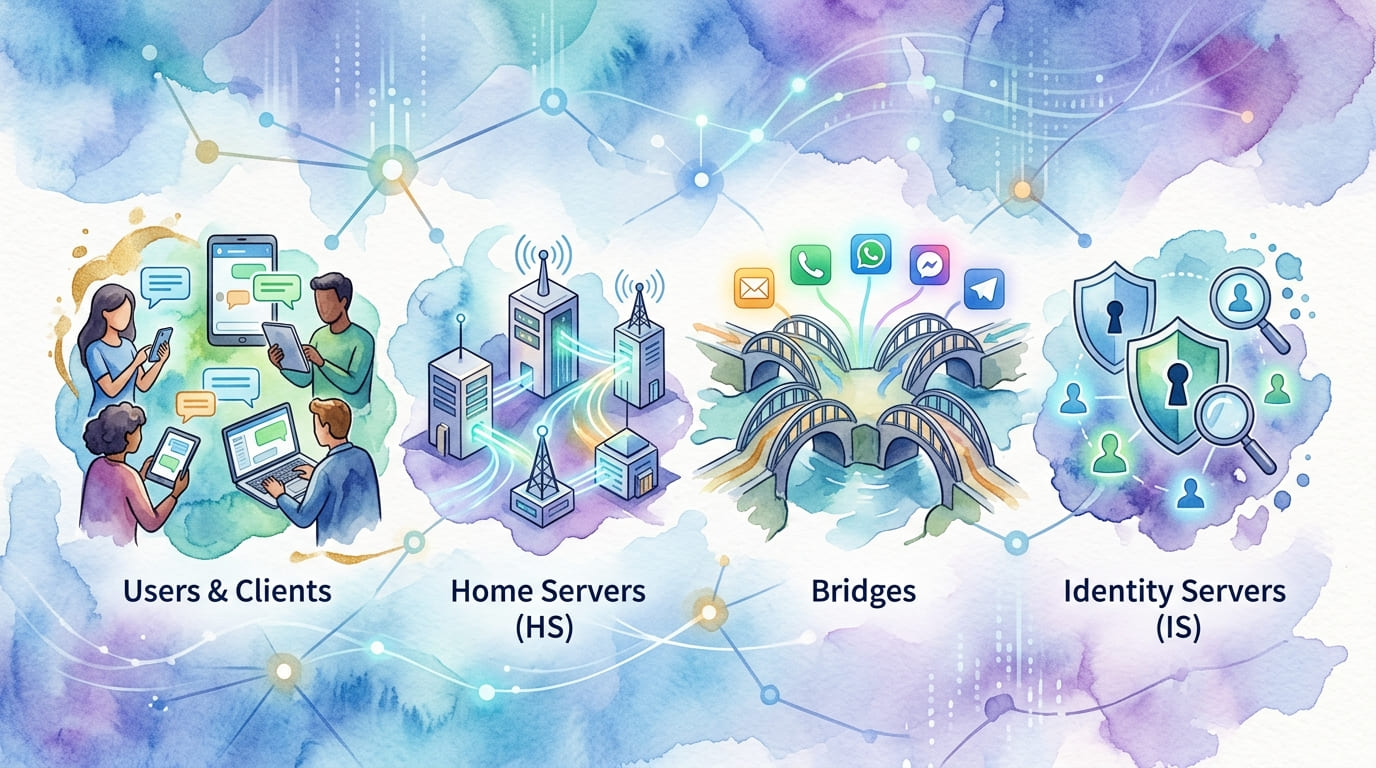
The architecture is built around four main components working together: the homeserver, the client, bridges, and identity and application services. Each can be developed, hosted, and maintained independently. This modularity is what gives the protocol its resilience. If one server goes down, others continue to operate. If you do not like a client, you can switch to another without losing your conversations.
This modular approach also explains why the Matrix ecosystem attracts so many developers. According to the Matrix.org Foundation, there were over 80,000 federated servers by the end of 2023, with steady annual growth. The protocol is not a monolithic product, it is a set of open specifications that anyone can implement, supported by an active and engaged open source community.
The Homeserver: The core of the network
The homeserver is the cornerstone of the entire Matrix infrastructure. It stores your messages, manages your chat rooms, and ensures communication with other servers in the network. When you create a Matrix account, you create it on a specific homeserver identified by a domain, for example @user:myserver.com. Two main implementations dominate the ecosystem: Synapse, written in Python and developed by the Matrix.org team, and Dendrite, a more recent Go-based alternative designed to consume fewer resources.
Data storage and conversation history
The homeserver stores the complete history of conversations involving its users. Every message, file shared, and reaction is stored locally. This ensures that your data remains under your control if you host your own server. A company, such as a small or medium-sized business, can install Synapse on a dedicated server hosted by providers like OVH or Scaleway and retain full control over internal communications, with a high level of technical support available within the ecosystem.
End-to-end encryption, based on the Olm protocol derived from Signal, is handled on the client side, while the homeserver stores encrypted messages. Even the server administrator cannot read the content of protected conversations. This is crucial for organizations subject to regulatory constraints such as GDPR and helps answer the question Is the Matrix application secure?.
Federation management between servers
Federation is what transforms Matrix from a simple chat server into a globally interconnected network. When a user on server A sends a message to someone on server B, the two homeservers communicate directly via the Server-Server API, also known as the Federation API. The protocol uses cryptographic signatures to verify the authenticity of messages exchanged between servers.
In practice, each chat room is replicated across all servers where at least one participant is present. There is no master server, each homeserver holds a complete copy of the room history. This distributed model makes the network resilient to failures and censorship since there is no single point of failure, clearly explaining How does the Matrix protocol work?.
The Matrix Client: The user interface
The client is what users interact with daily. It is the application, whether mobile, web, or desktop, that allows you to send messages, make calls, and manage chat rooms. The Matrix protocol strictly separates the client from the server, meaning you can switch applications without changing accounts or losing data.
Communication via the Client-Server API
All interactions between the client and the homeserver go through the Client-Server API, a well-documented REST interface. This API covers everything: authentication, message sending, room synchronization, encryption key management, and VoIP calls. A developer can build a functional Matrix client in just a few days thanks to this clear specification.
The API uses JSON over HTTPS, making it accessible to virtually all programming languages. SDKs exist for JavaScript, Python, Kotlin, Swift, and Rust, simplifying client development across platforms. Incremental synchronization allows the client to fetch only new events since the last connection, saving bandwidth.
Examples of popular clients like Element
Element, formerly Riot, remains the most well-known and feature-complete Matrix client. Available on web, Android, iOS, Windows, macOS, and Linux, it offers an experience comparable to Slack or Discord, with rooms organized into spaces, threads, reactions, file sharing, and integrated video conferencing via Jitsi or the native Element Call system.
However, Element is not the only option. Twake Chat, stands out as a highly relevant professional alternative within the Matrix ecosystem. Also built on this protocol, it provides secure instant messaging with end-to-end encrypted conversations, multi-device synchronization, and advanced integration with collaborative tools. Designed for enterprises and public organizations, Twake Chat can be deployed in the cloud or on-premise, ensuring full data control and compliance with digital sovereignty requirements. It also stands out for its ability to centralize multiple messaging platforms through bridges and its integration into a broader collaborative ecosystem. This approach directly addresses the challenges behind Are instant conversations with Matrix private?, while relying on an active open source community and structured technical support, offering a robust alternative to proprietary solutions.
FluffyChat offers a clean interface inspired by WhatsApp, ideal for less technical users. Nheko and Fractal target Linux users with native GTK or Qt interfaces. SchildiChat is a fork of Element with ergonomic improvements appreciated by the community. This diversity of clients perfectly illustrates the advantage of an open protocol: competition drives continuous improvement.
Bridges: Universal interoperability
Bridges are probably the most distinctive component of the Matrix ecosystem. Their role is to connect Matrix with third-party messaging platforms so you can communicate with users on WhatsApp, Telegram, or Signal directly from your Matrix client. It is essentially a universal translator between different communication systems.
Technically, a bridge is a service that connects both to the Matrix network via the Application Services API and to an external platform. It translates messages between formats in real time. Users from external platforms appear as virtual participants in your Matrix rooms, and vice versa.
Connecting with WhatsApp, Signal, and Telegram
The most mature bridges support major public platforms. mautrix-whatsapp allows sending and receiving WhatsApp messages from Element. mautrix-telegram does the same for Telegram, including group and sticker synchronization. mautrix-signal links your Signal account to Matrix.
In professional environments, bridges exist for Slack, Discord, Microsoft Teams, and IRC. The IRC bridge from matrix.org is one of the oldest and most stable. Bebridge, developed by a French team, offers a commercial hosted bridge solution for companies that prefer not to manage infrastructure themselves. With the European Digital Markets Act enforcing interoperability among major platforms, Matrix bridges could become even more relevant in the coming years.
Identity and Application Services
The fourth pillar of the Matrix architecture combines two complementary service types: identity servers and application services. These components, often overlooked, play a key role in user experience and protocol extensibility.
Identity servers for user discovery
A common challenge in decentralized systems is finding someone without knowing their exact Matrix ID. Identity servers solve this by linking third-party identifiers such as email addresses or phone numbers to Matrix accounts. If a colleague has linked their professional email to their account, you can find them simply by searching for that address.
The reference identity server is called Sydent, developed by the Matrix.org team. Associations are stored as cryptographic hashes to protect privacy. Users must explicitly validate each association and can revoke it at any time. This mechanism aligns with GDPR consent principles while enabling practical contact discovery.
Bots and third-party services via Application Services
Application Services represent the official extension mechanism of Matrix. Unlike standard bots that connect as regular users, an Application Service has special privileges: it can create virtual users, intercept events before distribution, and manage entire namespaces of identifiers.
The bridges mentioned earlier are technically Application Services. However, use cases go far beyond that: automated moderation bots, integrations with project management tools like GitLab, server monitoring alerts, or ticketing systems. Mjolnir, for example, is a moderation bot that protects large public rooms from spam and abuse. The possibilities are comparable to webhooks and apps in Slack, but with the advantage of running on an open and federated protocol.
The importance of synergy between these components
The four components of the Matrix protocol do not operate in isolation. Their strength lies precisely in how they interact. The homeserver stores and distributes data, the client makes it accessible to users, bridges extend the network to other platforms, and identity and application services add discovery and extensibility.
Consider a concrete example: a French local authority deploys Matrix for its staff. The homeserver runs on sovereign infrastructure. Employees use Element on their computers and phones. A bridge to government messaging systems enables communication with other administrations. An Application Service bot manages on-call duties and alerts. The identity server allows employees to find colleagues via their professional email. Each component fulfills its role, forming a complete and controlled communication system.
If you plan to deploy Matrix for your organization, start with the homeserver, Synapse for stability, Dendrite if resources are limited, add Element as the default client, and then gradually integrate the bridges and services you need. The ecosystem is mature enough for production use, and the French-speaking community remains active on dedicated matrix.org rooms.

