


 Français
The choice of an infrastructure is no longer limited today to a simple opposition between Cloud and On‑Premise. Organizations must balance performance, security, compliance, and data‑ownership concerns while preserving sufficient scalability. In this context, private‑cloud, hybrid, and on‑premise models coexist and address different needs.
To make an informed decision, it is essential to analyze business constraints, regulatory requirements, and the organization’s overall digital strategy. This reflection is fully embedded in a controlled and sustainable IT‑infrastructure approach.
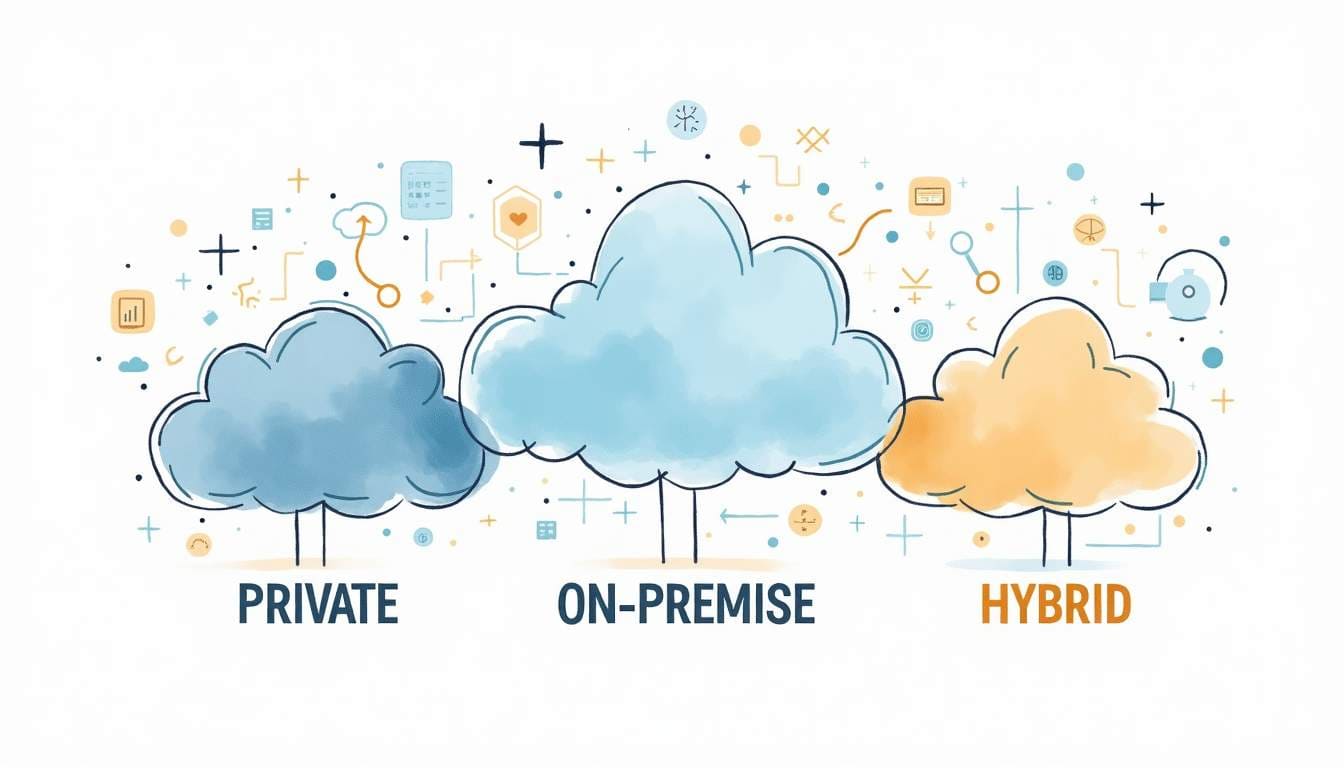
Understanding the different infrastructure models
On‑Premise: total mastery and control
The on‑premise model relies on infrastructures hosted and operated directly by the organization. It provides complete control over systems, data, and flows, making it a preferred option for sensitive or heavily regulated environments.
This model remains relevant when digital sovereignty and infrastructure mastery are strategic priorities, especially for certain public administrations and critical enterprises.
Private Cloud: flexibility and sovereignty
What is a private cloud? A private cloud combines the benefits of virtualization and automation with a high level of control. Deployed in a dedicated environment, it delivers cloud‑style flexibility while retaining ownership of data and infrastructure.
Built on open‑source technologies, the private cloud forms a solid foundation for constructing an evolving, interoperable infrastructure that aligns with sovereignty requirements.
Hybrid Cloud: reconciling agility and constraints
What is a hybrid cloud? A hybrid cloud merges on‑premise and cloud environments to leverage the advantages of each approach. For example, it allows sensitive data to stay in controlled on‑premise sites while exploiting cloud flexibility for specific workloads.
This approach requires a coherent IT architecture and clear governance to avoid complexity and to guarantee secure exchanges between the different environments.
Key criteria for choosing the right infrastructure
Security and compliance
Data security and regulatory compliance are decisive criteria when selecting an infrastructure. Depending on the industry, certain data may require specific hosting or strong guarantees regarding location and control.
Performance and scalability
Performance needs and scaling capacity must also be considered. A suitable infrastructure can evolve progressively, without disruption, to support the growth of digital services and usage.
The role of Open Source in modern infrastructures
Open Source plays a central role in designing flexible and durable infrastructures. It enables the standardisation of environments, automation of deployments, and reduction of technological lock‑in.
Integrated into on‑premise, private‑cloud, or hybrid models, Open Source promotes better mastery of the digital infrastructure and fits a long‑term sustainability logic for systems.
The importance of expert guidance in infrastructure choice
Choosing an infrastructure is not merely a technical decision; it is a strategic choice that commits the organization for the long term. Guidance from experts helps align technical options with business objectives and operational constraints.
LINAGORA’s open‑source services support organizations in analysing, designing, and evolving their infrastructures, leveraging open technologies and recognised expertise.
Conclusion
Private‑cloud, hybrid, or on‑premise: there is no universal model. The right choice depends on context, regulatory demands, and each organization’s digital strategy.
By adopting a pragmatic approach, Open Source technologies, and expert assistance, it is possible to build a coherent, scalable IT infrastructure aligned with the sovereignty and performance challenges championed by LINAGORA.

