


 Français
 Tunisie
Cloud security is no longer a purely isolated technical topic, it has become a major strategic issue for organizations migrating their information systems to cloud environments. CIOs, CISOs, and decision makers must not only understand the fundamentals, but also master architectures, responsibility models, and essential protection mechanisms in order to reduce risks, ensure data security, and guarantee business continuity in hybrid or multi cloud environments. This article sheds light on these key dimensions in a structured, educational, and decision oriented manner.
What is cloud security in a modern environment
Cloud security is defined as the set of practices, processes, technologies, and architectures designed to protect applications, data, identities, and services deployed in cloud environments. It covers the entire responsibility chain, from physical infrastructure to application usage and end users, by integrating proactive technical controls and organizational models adapted to the chosen architecture.
Cloud security architecture
Cloud security architecture is the conceptual and technical framework that organizes the components and mechanisms used to protect a cloud environment. This architecture is based on several fundamental principles:
Confidentiality
ensuring that only authorized entities can access sensitive information, for example through strict access control policies and end to end encryption of data in transit and at rest.
Integrity
ensuring that data cannot be altered without detection, by using hashing functions and mechanisms to audit changes.
Availability
maintaining access to services and data for legitimate users, which often requires redundant architectures and disaster recovery plans.
These principles are not independent, they must be integrated into a global architecture combining network, identity, storage, and orchestration layers to provide consistent and resilient protection.
The shared responsibility model
One of the conceptual pillars of cloud security is the shared responsibility model. This model clarifies the distribution of responsibilities between the cloud service provider and the customer organization.
Principle of the model
- Cloud service provider (CSP): responsible for the security of the cloud itself, meaning the physical infrastructure, networks, hypervisors, and underlying components.
- Cloud customer: responsible for what it runs and configures in the cloud, including application protection, access policies, service configuration, and the security of hosted data.
This distinction is essential to avoid common misunderstandings within IT teams, where part of the security effort inherently falls on the customer.
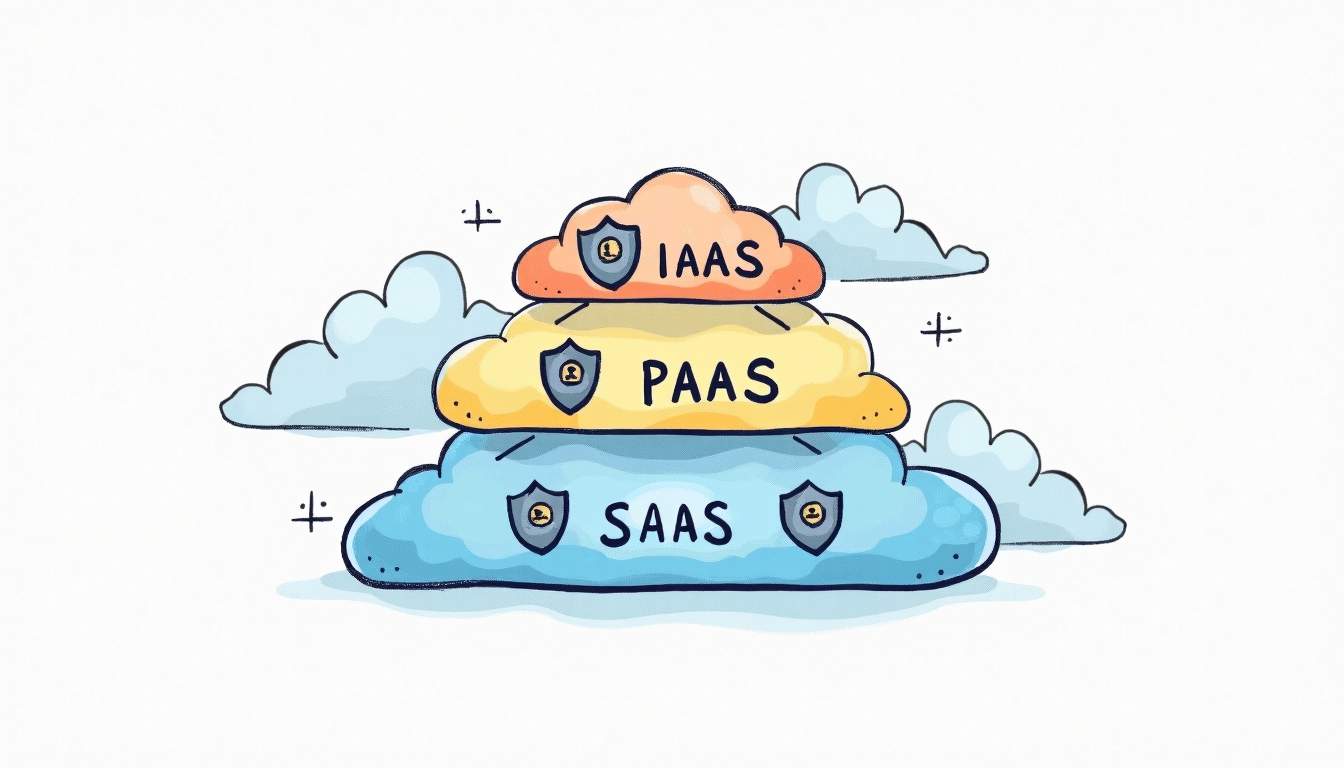
Variation depending on service models
The level of responsibility varies depending on the type of cloud service:
- IaaS (Infrastructure as a Service) : the customer manages almost everything except the physical infrastructure.
- PaaS (Platform as a Service) : the CSP takes care of more layers, while the customer remains responsible for applications and configurations.
- SaaS (Software as a Service) : the provider generally manages the application, but the customer must secure usage, particularly authentication and configured data.
This detailed understanding is essential for decision makers to correctly arbitrate responsibilities within their software security and cloud operations strategy.
Essential protection mechanisms
To implement robust cloud security, several technical and organizational mechanisms must be integrated:
Encryption and key management
Beyond traditional encryption of data at rest and in transit, approaches such as Bring Your Own Encryption allow an organization to use its own encryption keys and retain control over confidentiality, even in an outsourced environment.
Identity and access management
One of the most frequently exploited attack vectors remains credential compromise. Robust identity management policies, combined with strong authentication solutions, significantly reduce the attack surface.
Integration into the development lifecycle
Security can no longer be a late addition, security software must be integrated from the design phase of cloud applications, following a DevSecOps approach and shift left practices that allow vulnerabilities to be identified earlier in the development lifecycle.
Monitoring and detection
Modern monitoring and response tools, including unified cloud native application protection platforms, make it possible to quickly detect and remediate anomalies or potential attacks, thereby strengthening the effectiveness of the security architecture.
Conclusion
Cloud security is not a single concept but a combination of robust architectures, a clear understanding of responsibility models, and the integration of advanced protection mechanisms. An effective strategy relies on close collaboration between internal teams, mastery of architectural concepts, and solid technical implementation of functions such as end to end encryption, proactive identity management, and security by design.
For IT decision makers, adopting this structured vision is essential not only to protect digital assets, but also to strengthen operational resilience and stakeholder trust in their cloud initiatives, by relying on proven open source security principles that promote transparency, auditability, and technological control.

