


 Français
Imagine deploying code to production without ever worrying about a server, an operating system, or a security patch at the infrastructure level. That is precisely the promise of serverless computing, a cloud‑architecture model that has profoundly changed how technical teams design and deliver their applications. Since the early experiments of the mid‑2010s, this approach has matured, and by 2026 it represents a significant share of workloads hosted in the public cloud. Yet, despite its growing adoption, many professionals remain unclear about what the term “serverless” truly covers, its internal mechanisms, concrete benefits, and real‑world limitations. Serverless technology: everything you need to know has become a central question for companies looking to modernize their infrastructures and optimise cloud costs. This article provides a clear, direct overview.
Definition and fundamental principles of serverless
Serverless, or “computing without servers,” does not mean that there are no servers at all. Physical and virtual machines continue to run somewhere, of course. The fundamental difference is that developers no longer have to concern themselves with those machines. The cloud provider handles the entire infrastructure management: provisioning, maintenance, scaling, and security patches. Developers focus solely on business code and application logic.
Serverless in modern cloud computing thus represents a major evolution toward greater automation and abstraction of technical resources.
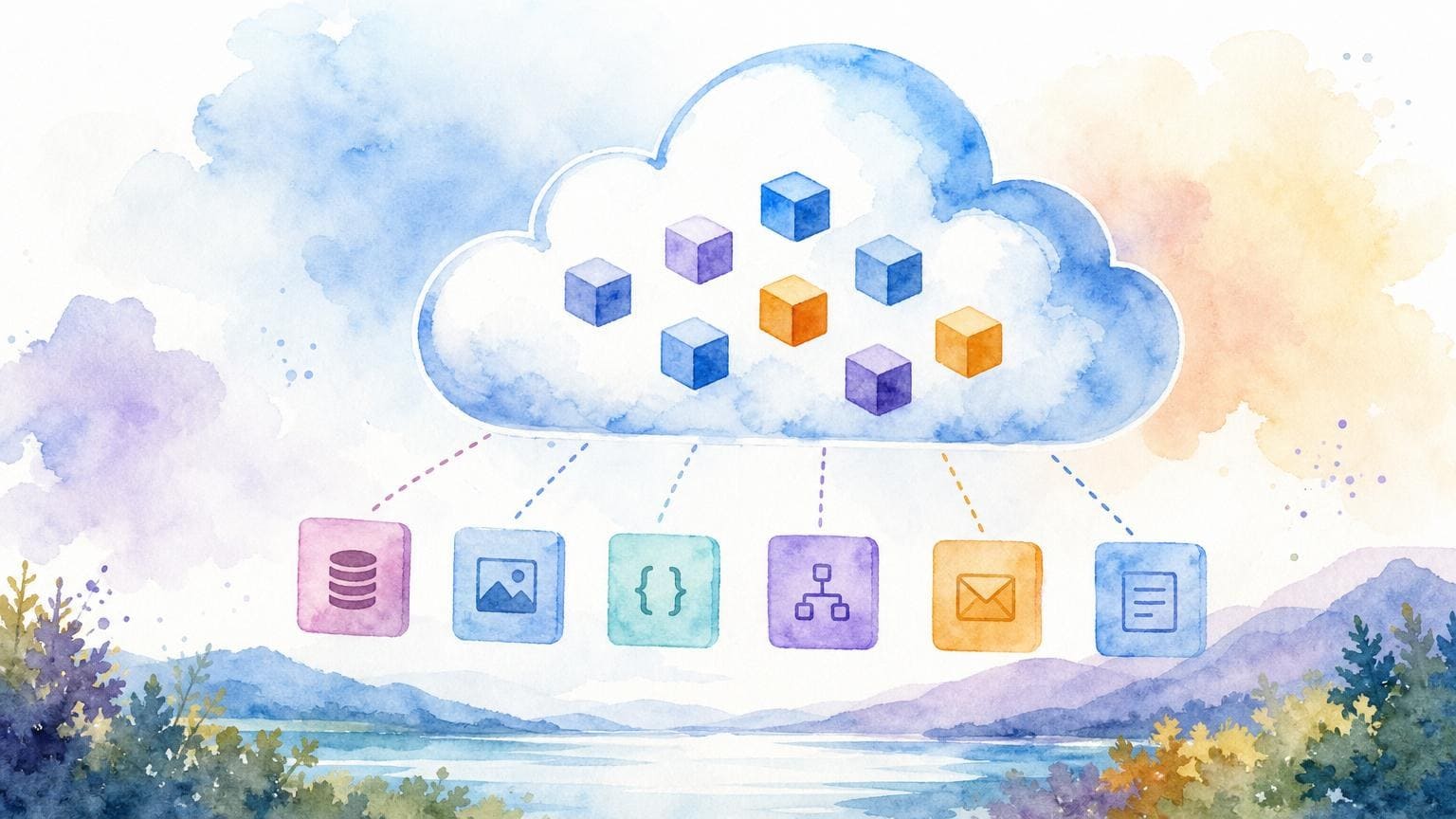
The model rests on two main pillars: Function‑as‑a‑Service (FaaS) and Backend‑as‑a‑Service (BaaS). Together they form an ecosystem where resources are allocated dynamically, billed per execution, and released as soon as the task completes.
L'abstraction de la gestion des serveurs
The central principle of serverless is summed up in one word: abstraction. In an IaaS (Infrastructure‑as‑a‑Service) model you must pick a virtual‑machine size, configure networking, and manage OS updates; serverless removes all those layers from the developer’s responsibility. You write a function, you deploy it, and the provider takes care of the rest.
For organisations asking “Serverless computing vs. cloud: what’s the difference?”, it is important to understand that serverless is an execution model within cloud computing, whereas cloud denotes the whole portfolio of remotely accessible IT services delivered over the Internet.
This abstraction goes further than a simple PaaS (Platform‑as‑a‑Service) such as Heroku or Cloud Foundry. With PaaS you still run containers or application instances continuously. In serverless, nothing runs if nobody invokes your code. This fundamental difference has direct implications for cost and architecture.
The concept of Function‑as‑a‑Service (FaaS)
FaaS is the most visible component of serverless. It lets you deploy individual functions, isolated code fragments that run in response to a specific event. An HTTP request, a message in a queue, a file dropped into a storage bucket: each of these events can trigger a function execution.
Each function has a short lifetime: it starts, processes the request, returns a result, then stops. No resident process remains in memory between invocations. This ephemerality pushes developers toward stateless design, naturally fostering decoupled and resilient architectures.
Backend‑as‑a‑Service (BaaS)
BaaS complements FaaS by providing ready‑made managed services: databases, authentication, push notifications, file storage, etc. Google’s Firebase is the best‑known example. Rather than deploying and maintaining your own authentication server, you call a managed API that handles users for you.
In a serverless architecture, BaaS further reduces the amount of code and infrastructure you have to maintain. A front‑end developer can build a complete application by combining FaaS functions with BaaS services, without ever touching a server or configuring a reverse proxy.
Key benefits for developers and enterprises
Why are so many organisations migrating to serverless in 2026? The answer lies in three concrete benefits that address real‑world problems.
Automatic scaling and elasticity
One of the most striking strengths of serverless computing is its ability to scale automatically with load. If your app receives 10 requests per minute, the provider allocates resources for 10 executions. If a traffic spike pushes that number to 10 000 requests per minute, the infrastructure expands instantly with no manual intervention.
This elasticity is especially valuable for workloads with unpredictable traffic: an e‑commerce site on Black Friday, a ticket‑sale platform for a popular concert, or an API service experiencing seasonal spikes, all benefit from seamless scaling. No more provisioning “just in case” servers and paying for idle capacity 90 % of the time.
Pay‑as‑you‑go pricing model
Serverless economics differ radically from traditional hosting. You pay only for the actual execution time of your functions, measured in milliseconds, and for the memory allocated during that execution. If a function does not run, you pay nothing.
For a startup launching a new product, this is a huge advantage: no fixed costs for 24/7 servers, no commitment to reserved instances. AWS Lambda, for example, offers one million free executions per month in 2026. Light or intermittent workloads can therefore cost just a few euros per month.
Warning: for constantly heavy workloads, the model can become more expensive than a dedicated server. Cost analysis must be performed case‑by‑case.
Faster time‑to‑market
Removing infrastructure management frees engineering time for what truly matters: the product. Teams that adopt serverless typically see noticeable acceleration of delivery cycles. Deploying a new feature is as simple as pushing a function to the cloud, without worrying about cluster capacity or load‑balancer configuration.
This speed also encourages experimentation. Testing a product hypothesis costs little in serverless: you deploy a function, measure results, and delete it if it does not convince. The short loop between idea and production test is a genuine competitive advantage for agile product teams.
Technical operation of a serverless architecture
Understanding the internal workings of serverless helps you use it effectively and avoid common pitfalls. How does serverless computing work? The principle relies on on‑demand execution triggered by specific events. When an event occurs, the cloud provider automatically allocates the resources needed to run the code, then releases them as soon as the task finishes. This approach maximises resource utilisation while reducing operational costs.
Triggers and event‑driven execution
Serverless architecture is fundamentally event‑driven. Each function is linked to one or more triggers that cause its execution. Triggers can be:
- An incoming HTTP request via an API Gateway
- A message published to a queue such as SQS, Pub/Sub or Event Hubs
- A change in a database (insert, update, delete)
- A file uploaded to an object‑storage service
- A scheduled (cron) event for recurring jobs
When a trigger fires, the provider spins up an execution environment, loads the function code, runs it with the event data as input, and then tears down the resources. This cycle repeats for every invocation, making each execution independent of the others.
Function lifecycle management
The provider maintains a pool of execution environments for each deployed function. The first invocation creates a new environment, known as a cold start. Subsequent invocations that arrive quickly reuse the still‑warm environment (warm start), reducing latency.
The environment stays alive for a variable idle period, typically 5 – 15 minutes, depending on the provider, after which it is destroyed. This explains why serverless functions must be stateless: any data kept in memory between invocations can disappear without warning. Persistent data should be stored externally in a database or a distributed cache such as Redis.
Limits and challenges of adopting serverless
Serverless is not a universal solution. Several technical and organisational constraints deserve serious attention before committing.
Cold‑start problem
Cold starts remain the Achilles’ heel of serverless. When a function hasn’t been invoked for a while, the provider must create a fresh runtime, load the language interpreter, initialise dependencies, and run any startup code. This can take tens of milliseconds to several seconds, depending on language and dependency size.
For an API that must respond within 100 ms, an 800 ms cold start is unacceptable. Functions written in Python or Node.js generally start faster than those in Java or C#. Providers offer mitigations (e.g., provisioned concurrency on AWS or minimum‑instance settings on Google Cloud), but these add a fixed cost that erodes the economic benefit of the model.
Vendor lock‑in
Each cloud vendor implements serverless in its own way. Trigger formats, configuration options, execution limits, and associated services differ between AWS Lambda, Google Cloud Functions, and Azure Functions. A Lambda‑compatible function will not deploy unchanged to Cloud Functions without modifications.
This technical dependence makes migration between providers costly and complex. Frameworks such as the Serverless Framework or the open‑source Knative project attempt to abstract away these differences, yet the abstraction remains imperfect. In 2026, true multicloud serverless is still a challenging goal. Companies must factor this risk when selecting a platform.
Debugging and monitoring complexity
Debugging a serverless application is notoriously harder than debugging a monolithic app. Code runs in a remote, transient environment, making local reproduction of bugs difficult. Local development tools (e.g., SAM CLI, Serverless Offline) emulate the cloud environment, but behavioural gaps between emulator and real runtime are common.
Monitoring presents its own challenges. A typical serverless system may involve dozens, or hundreds, of interconnected functions. Tracing a request across this chain requires distributed‑tracing tools such as AWS X‑Ray, Datadog, or OpenTelemetry. Without robust observability, pinpointing the source of an error in a multi‑function system becomes a nightmare.
Common use cases and popular platforms
Serverless shines in certain scenarios and is less suitable in others. Identifying the right use cases is essential to reap its benefits.
Data processing and microservices
Event‑driven data processing is arguably the most natural serverless use case. Auto‑resizing images on upload, transforming CSV files into database rows, or kicking off processing pipelines per new message, all are isolated, short‑lived tasks that fit the FaaS model perfectly.
Microservice architectures also benefit, provided each service has a well‑defined functional boundary. REST or GraphQL APIs exposed via an API Gateway, webhooks, conversational bots, and scheduled background jobs are all scenarios where serverless adds clear value. Conversely, applications that require long‑lived connections (e.g., persistent WebSockets) or heavy workloads exceeding execution‑time limits (15 minutes on AWS Lambda) are better served by containers or VMs.
Landscape of solutions: AWS Lambda, Google Cloud Functions, Azure Functions
AWS Lambda has dominated the FaaS market since its 2014 launch. By 2026 it supports more than a dozen languages, offers deep integration with the AWS ecosystem, and provides advanced features such as Lambda Layers and response streaming.
Google Cloud Functions focuses on simplicity and tight integration with Google services (BigQuery, Firestore, Pub/Sub). Its second generation, built on Cloud Run, adds container‑support flexibility.
Azure Functions appeals to Microsoft‑centric organisations with native integration to Azure DevOps, Active Directory, and .NET services.
The choice among these platforms often depends more on the existing technology stack than on fundamental technical differences.
The future of cloud: towards ubiquitous serverless adoption
Serverless is no longer an emerging technology. The majority of new cloud‑native projects incorporate at least one serverless component. Improvements in cold‑start latency, development tooling, and interoperability standards are making the approach accessible to a far wider spectrum of enterprises.
The clear trend is a convergence of serverless and containers. Services such as AWS Fargate or Google Cloud Run already blur the line, delivering a serverless experience (no server management, automatic scaling, pay‑per‑use) while preserving container flexibility. This hybrid model lets teams pick the best tool for each architectural component without being locked into a single paradigm.
For organisations embarking on this transition, choosing a reliable technology partner often makes the difference between a successful project and a stalled one. LINAGORA supports businesses in their digital transformation with open-source solutions tailored to their needs, offering both the flexibility of open-source software and robust professional technical support.
Serverless computing will not replace every existing architecture, but it redefines expectations around simplicity, cost, and development velocity. Teams that master its strengths and acknowledge its limits gain a concrete advantage in building modern, efficient, and economically viable applications.

