


 Français
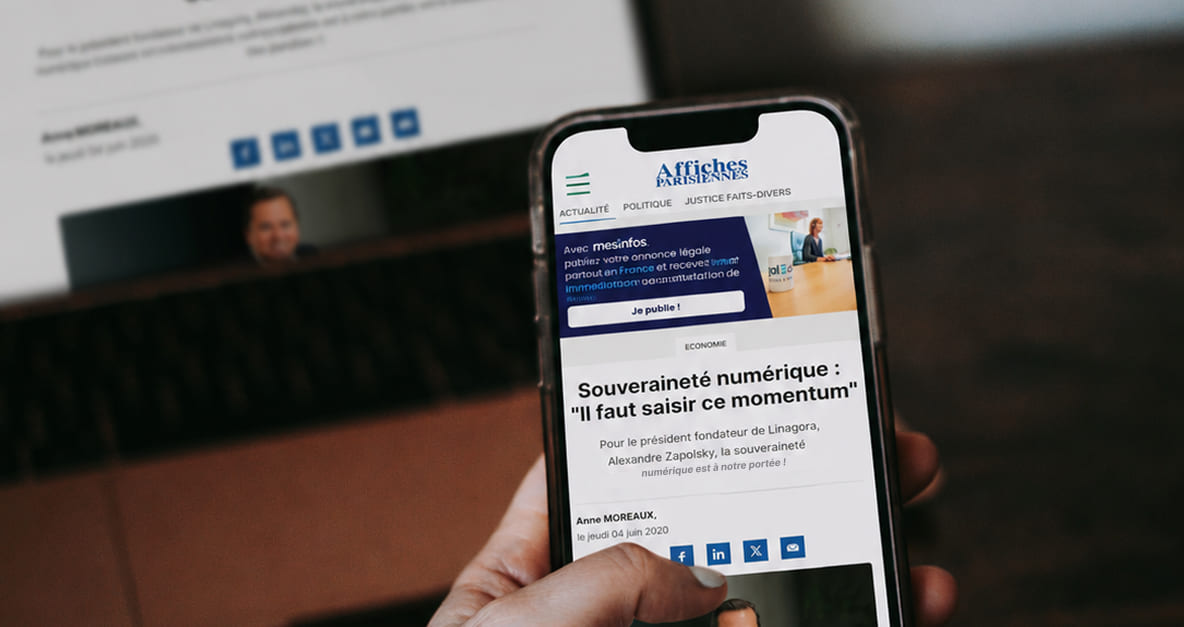
Digital Sovereignty: “We must seize this moment.”
That is the headline chosen by Les Affiches Parisiennes for its interview with Alexandre Zapolsky, founder‑president of LINAGORA.
And it is probably the main takeaway from the piece: for years Europe has been talking about digital sovereignty, but rarely have the conditions seemed so ripe to move from discussion to action.
The recent European package on technological sovereignty, the growing recognition of open‑source as a strategic asset, the acceleration of public and private investment in digital technologies, and the debates surrounding artificial intelligence all signal a genuine change of direction.
For the first time in a long while, digital sovereignty no longer appears as a distant ambition; it is becoming an industrial strategy.
The article recalls a conviction that Alexandre Zapolsky has held for more than a quarter of a century: Europe will regain its full capacity to act only if it masters its data, and now its AI models as well.
Because behind software, collaborative platforms, cloud services, and artificial intelligence lies a much broader question: our ability to choose our own digital future, aced with a U.S. model dominated by hyperscalers and a Chinese model that is highly centralized, Europe has a card to play.
A European digital future built on openness.
A path founded on interoperability, transparency and technological mastery.
And that path already exists: for 26 years, LINAGORA has been building open‑source alternatives that sit at the heart of the information systems of large administrations and organisations. Today that ambition continues through twake.ai, linshare.app, linto.ai, open-rag.ai, and Luciole in the field of open artificial intelligence.
Thank you to Anne Moreaux and the Affiches Parisiennes team for the interview.
And thanks to everyone who contributes every day to keeping this vision of an open, sovereign, and European digital ecosystem alive.

