


 Français
 Tunisie
The development of mobile and web applications has radically changed in recent years. Where a team once had to spend weeks configuring servers, databases, and authentication systems, it is now possible to delegate this entire technical layer to a third‑party service. This is precisely the promise of Backend as a Service, or BaaS: to provide developers with a ready‑to‑use backend infrastructure, accessible via APIs, so they can concentrate on what truly matters, the user experience and the business logic of their application. But concretely, how does it work? What are the real gains, the pitfalls to avoid, and how do you choose the right platform for your project? Here is a complete tour of the topic.
Definition and Fundamental Principles of BaaS
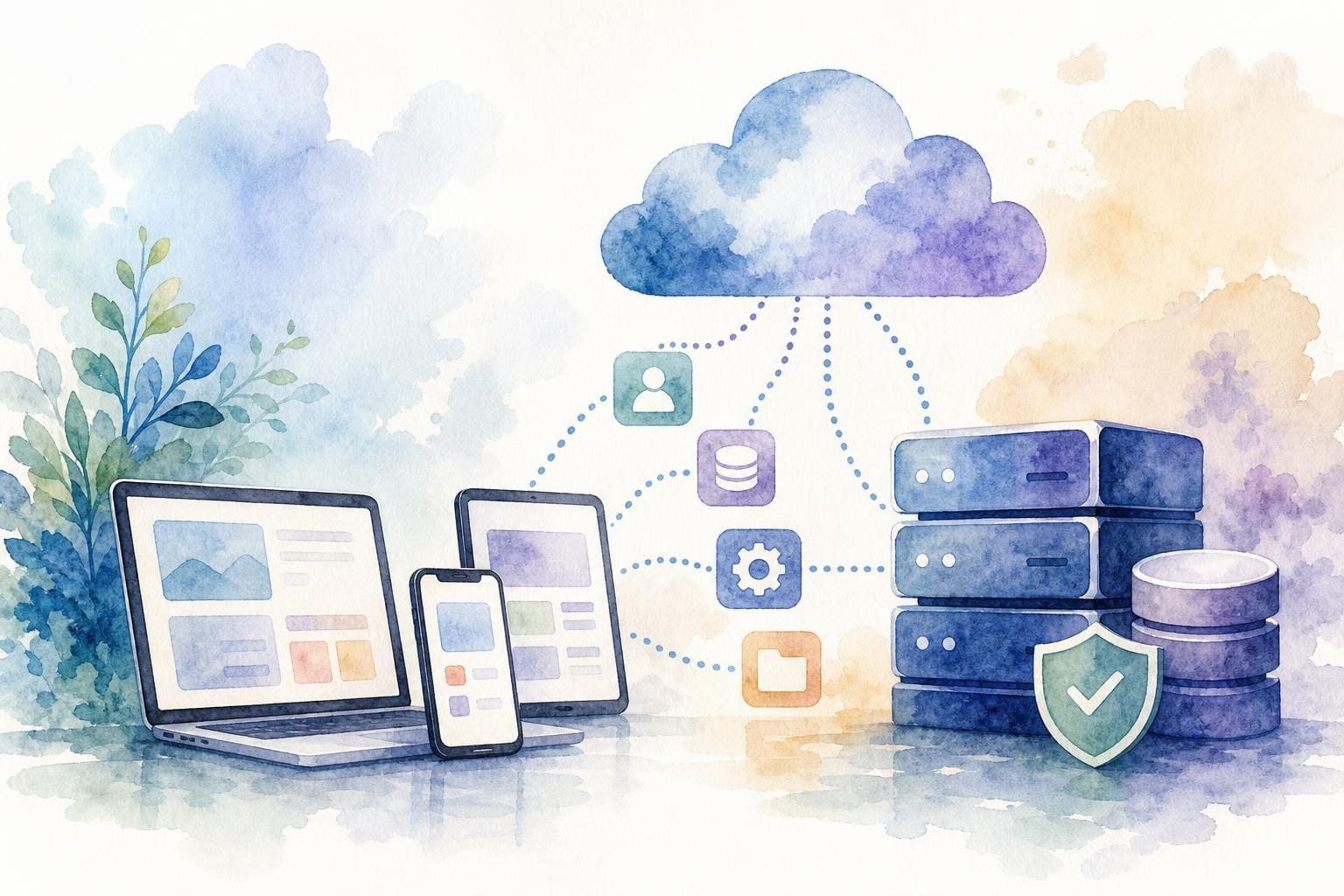
Backend as a Service denotes a category of cloud services that takes care of the entire server layer of an application. In practice, instead of coding, deploying, and maintaining a custom backend, the developer uses a platform that exposes ready‑to‑consume features: data storage, authentication, file management, notifications, and many other technical bricks. Everything is reachable through SDKs (software development kits) and standardized APIs.
The central idea is simple: abstract backend complexity. A frontend or mobile developer can therefore build a complete application without ever touching a server‑side configuration file, without managing security updates on the infrastructure, and without worrying about scaling. The BaaS provider handles all that in the background.
This model has gradually taken hold since the early 2010s, with the explosion of mobile development. In 2026 it represents a market estimated at more than $25 billion worldwide, driven by the multiplying number of apps and the shortage of qualified backend developers.
How Does Backend as a Service Work?
The technical principle relies on a classic client‑server architecture, but the server side is entirely managed by the provider. When a developer integrates a BaaS into a project, they usually install an SDK adapted to their platform (iOS, Android, Web, Flutter, React Native) and start calling predefined methods to interact with the backend.
Concrete example. You are developing a task‑management app. Rather than creating a PostgreSQL database, writing a REST API with Express or Django, configuring an OAuth2 authentication system, and deploying everything on a server, you use the SDK of your BaaS provider. In a few lines of code you can create a user, store a task in the database, send a push notification when a task is assigned, and synchronize data in real time between several devices.
The provider takes care of high availability, backups, network security, and updates. The developer focuses exclusively on client‑side code.
The Distinction Between BaaS, SaaS and PaaS
The confusion among these three acronyms is frequent, and it deserves clarification. SaaS (Software as a Service) delivers a complete ready‑to‑use software: think Slack, Google Workspace or Salesforce. The end user consumes the product directly, without writing a single line of code.
PaaS (Platform as a Service) offers an execution environment to deploy custom code. Platforms like Heroku, Google App Engine or Clever Cloud belong to this category. The developer writes their own backend but does not have to manage the underlying infrastructure (servers, operating system, network).
BaaS goes one step further than PaaS in terms of abstraction. The developer does not write backend code: they use ready‑made functionalities. This is the fundamental difference. With a PaaS you code your own API. With a BaaS the API already exists, and you consume it. BaaS therefore sits between PaaS (too technical for some projects) and SaaS (too rigid to build a custom application).
Key Features Offered by BaaS Solutions
BaaS platforms do not merely provide an online database. They propose a complete ecosystem of services that cover almost the entire set of backend needs of a modern application. The functional scope varies from one provider to another, but certain bricks appear systematically.
What makes these platforms attractive is the coherence of the whole. Each service is designed to work with the others: authentication is linked to database access rules, file storage is protected by the same security policies, and push notifications can be triggered by database events. This native integration saves a considerable amount of time compared with manually assembling independent services.
Database Management and Cloud Storage
This is the heart of any BaaS. Most platforms offer a NoSQL (document‑type) or relational database, accessible directly from client code. Firebase, for instance, provides Firestore, a document‑oriented database with real‑time synchronization. Supabase, on the other hand, relies on PostgreSQL, which attracts developers accustomed to SQL.
File storage (images, videos, PDFs) is usually included as “buckets” in the cloud, with access‑rights management, automatic thumbnail generation for images, and an integrated CDN for fast international distribution. A developer can thus let users upload a profile picture in three lines of code, with automatic resizing and caching.
Database security rules deserve special attention. Since client code accesses the database directly (without an intermediate backend), precise rules must be defined to control who can read or write what. This aspect is often underestimated by teams discovering BaaS.
Authentication and User Management
Implementing a reliable and secure authentication system is one of the most time‑consuming backend tasks. BaaS solutions integrate user‑account management natively with:
- Email/password registration and login
- Authentication via third‑party providers (Google, Apple, GitHub, Facebook)
- Magic‑link or OTP‑by‑SMS authentication
- Session handling and JWT token management
- Password reset and email verification
All of this is available through ready‑made SDK methods. The developer does not have to worry about password hashing, token rotation, or protection against brute‑force attacks. In 2026, most BaaS providers also integrate passkeys (FIDO2), which are gradually replacing traditional passwords.
Push Notifications and Third‑Party Integrations
Push notifications are a crucial engagement lever for mobile applications. BaaS platforms allow sending targeted notifications to specific users or segments without managing the APNs (Apple) or FCM (Google) certificates yourself. The developer defines trigger conditions, and the BaaS handles the delivery.
Beyond notifications, modern BaaS platforms offer integrations with third‑party services: payment gateways (Stripe, Mollie), emailing services (SendGrid, Mailgun), analytics tools, and sometimes even serverless functions to execute custom server‑side code when standard features are insufficient. These serverless functions (called Cloud Functions on Firebase, Edge Functions on Supabase) constitute a valuable safety valve: they let you step outside the predefined BaaS framework without reverting to a full backend.
Strategic Advantages for Developers
Choosing a BaaS is not only a technical decision. It is a strategic one that impacts delivery speed, costs, and the very composition of development teams. For startups, agencies, and small product teams, the benefits are especially tangible.
A competent frontend developer can, with a BaaS, deliver a functional MVP alone in a few days. This represents a profound shift in how digital products are conceived and launched. “Full‑stack” profiles that master a frontend framework and a BaaS are increasingly sought after on the French job market in 2026.
Accélération du Time-to-Market
This is the most obvious argument, and it is measurable. A Gartner 2025 study estimated that using a BaaS reduces MVP development time by 40 % to 60 % compared with a custom backend architecture. Concretely, what took three months for a team of four developers can be achieved in four to six weeks by two frontend developers.
The acceleration stems from the fact that the most time‑consuming features (authentication, database management, file storage, notifications) are already implemented, tested, and maintained. The developer only has to configure and integrate them. There is no server‑deployment phase, no DevOps configuration, no backend CI/CD pipeline to set up.
For a French startup aiming to validate an idea quickly before a fundraising round, this time gain can be the difference between being first to market or arriving too late.
Reduction of Infrastructure and Maintenance Costs
BaaS business models usually rely on a free tier (sufficient for prototyping and small projects) and paid plans that scale with usage. Firebase offers a generous free tier (Spark Plan), and Supabase provides 500 MiB of database space and 1 GiB of file storage for free.
This usage‑based pricing means a startup only pays for what it actually consumes. No idle dedicated server costing €200 per month while waiting for the first users. No maintenance costs: the provider handles security updates, backups, and scaling.
Human costs decline as well. Not needing a senior backend developer full‑time (a profile billed between €500 and €700 per day in France in 2026) represents a considerable saving. Teams can stay smaller and more agile, which is a strong asset for budget‑constrained structures.
Limits and Points of Vigilance
BaaS is not a miracle solution. Like any architectural choice, it comes with trade‑offs that must be evaluated honestly before committing. Some projects simply are not suited to this model, and ignoring the limits can become costly in the medium term.
The two main risks revolve around vendor dependence and technical constraints inherent to a pre‑designed system. Knowing them in advance allows informed decisions and, in some cases, mitigation strategies from the start.
Vendor Lock‑in
This is the most debated point in the technical community. When you build your app on Firebase, your code uses the Firebase SDK, your data lives in Firestore, and your business logic depends on Google’s Cloud Functions. Migrating to another provider requires rewriting a significant portion of the code.
The Parse shutdown by Facebook in 2017 remains a textbook case. Thousands of apps suddenly found themselves without a backend (fortunately, Parse was open‑sourced, limiting the damage). The risk is real even with giants like Google.
Strategies to limit lock‑in:
- Isolate BaaS calls behind an abstraction layer (a “repository pattern”) so you can swap providers without rewriting the whole app.
- Prefer open‑source BaaS such as Supabase, Appwrite, or Nhost, which can be self‑hosted if needed.
- Export your data regularly in a standard format (CSV, JSON, SQL dump).
- Avoid using highly provider‑specific features when a more portable alternative exists.
Customization and Scalability Constraints
A BaaS works excellently as long as your project fits within the platform’s intended use cases. Once you need complex server‑side business logic, highly specific database queries, or real‑time processing with advanced rules, you hit the model’s limits.
Serverless functions provide a partial exit, but they have their own constraints: limited execution time (typically 60‑540 seconds), cold starts that add latency, and sometimes cumbersome debugging. For an e‑commerce platform with a custom recommendation engine, a complex stock‑management system, and ERP integrations, a BaaS alone will likely be insufficient.
Scalability is another topic. BaaS providers manage typical scaling well for CRUD, authentication, and storage workloads. However, for applications with millions of simultaneous writes or ultra‑low latency requirements, performance can become a bottleneck, and you have few levers to improve it because you don’t control the underlying infrastructure.
Panorama of the Main Market Players
The BaaS market is structured around a few major players, each with a distinct positioning. Below are the platforms most used by developers in France and Europe.
Firebase (Google), the historic leader. Its ecosystem is the most complete: Firestore, Authentication, Cloud Functions, Hosting, Analytics, Crashlytics, Remote Config. Tight integration with Google Cloud is an asset for projects that will grow. Main drawback: strong vendor lock‑in and a NoSQL database (Firestore) that doesn’t suit every data model.
Supabase, the reference open‑source alternative. Based on PostgreSQL, it attracts developers who want SQL power with BaaS simplicity. Authentication, storage, Edge Functions and real‑time sync are included. Being open source allows self‑hosting, greatly reducing lock‑in risk.
Appwrite, also open source, it stands out for its “self‑hosted first” approach. It offers similar functionalities to Firebase (database, auth, storage, functions) with a data‑sovereignty philosophy that resonates with French and European companies concerned about GDPR.
AWS Amplify (Amazon) targets developers already in the AWS ecosystem. It leverages existing AWS services (Cognito, DynamoDB, S3, Lambda) and exposes them through a unified SDK. Powerful but with a steeper learning curve than Firebase or Supabase.
Nhost (built on Hasura + PostgreSQL) and PocketBase (a single‑executable BaaS ideal for prototyping) also deserve mention. Choice depends on project size, team skills, regulatory constraints, and budget.
Choisir le BaaS adapté à votre projet
The choice of a BaaS platform should never be based on popularity or the number of GitHub stars. It must be guided by the concrete needs of your project and the constraints of your team. Here are the criteria that truly matter.
Start with your data model. If your application relies on complex relationships between entities (users, orders, products, categories), a relational database such as PostgreSQL (Supabase, Nhost) will be more suitable than a NoSQL database (Firebase). Conversely, for unstructured or highly hierarchical data, Firestore can be an excellent choice.
Then assess your team’s skills. A team of React or Vue.js developers with no backend experience will adapt more quickly to Firebase, whose documentation and tutorials are among the best on the market. A team with SQL expertise will probably prefer Supabase.
The issue of data sovereignty is central for projects subject to GDPR. European hosting is a selection criterion for many French companies. Supabase offers European regions, and Appwrite can be self‑hosted on a French server (OVHcloud, Scaleway).
Finally, look ahead to 12–18 months. If your application is destined to become complex with heavy backend processing, plan from the start a hybrid architecture: a BaaS for standard features, and a custom backend micro‑service for advanced business logic. This approach combines the best of both worlds.
BaaS is neither a passing fad nor a universal solution. It is a powerful tool, suitable for a wide range of projects, that allows you to build faster and at lower cost. The key, as often in software engineering, lies in choosing the right tool for the right context. Ask yourself the right questions, test two or three platforms on a small project, and you will quickly know which one matches your way of working.

