


 Français
 Tunisie
An amount of data difficult to imagine for the human mind is produced every day by businesses, governments, and individuals. A subway trip validated by a Navigo card, an order placed on an e-commerce site, a sensor installed on an offshore wind turbine in the North Sea: each of these actions leaves a digital trace. Taken individually, these traces seem insignificant. Combined, cross-referenced, and analyzed, they become a strategic resource that transforms how organizations make decisions, produce, and serve their customers.
Understanding this phenomenon is no longer reserved for engineers. Executives, marketing managers, legal experts, and elected officials must now master its key principles, if only to ask the right questions of their technical teams. The subject also raises issues that go beyond technology: Europe’s digital sovereignty, the protection of privacy, and the energy efficiency of infrastructure.
Here, we offer a comprehensive and accessible overview of what Big Data truly is. We explore its origins, foundations, tools, practical applications, and limitations. Our conviction is simple: data is only valuable if it is processed with rigor, transparency, and responsibility.
The emergence and definition of the Big Data concept
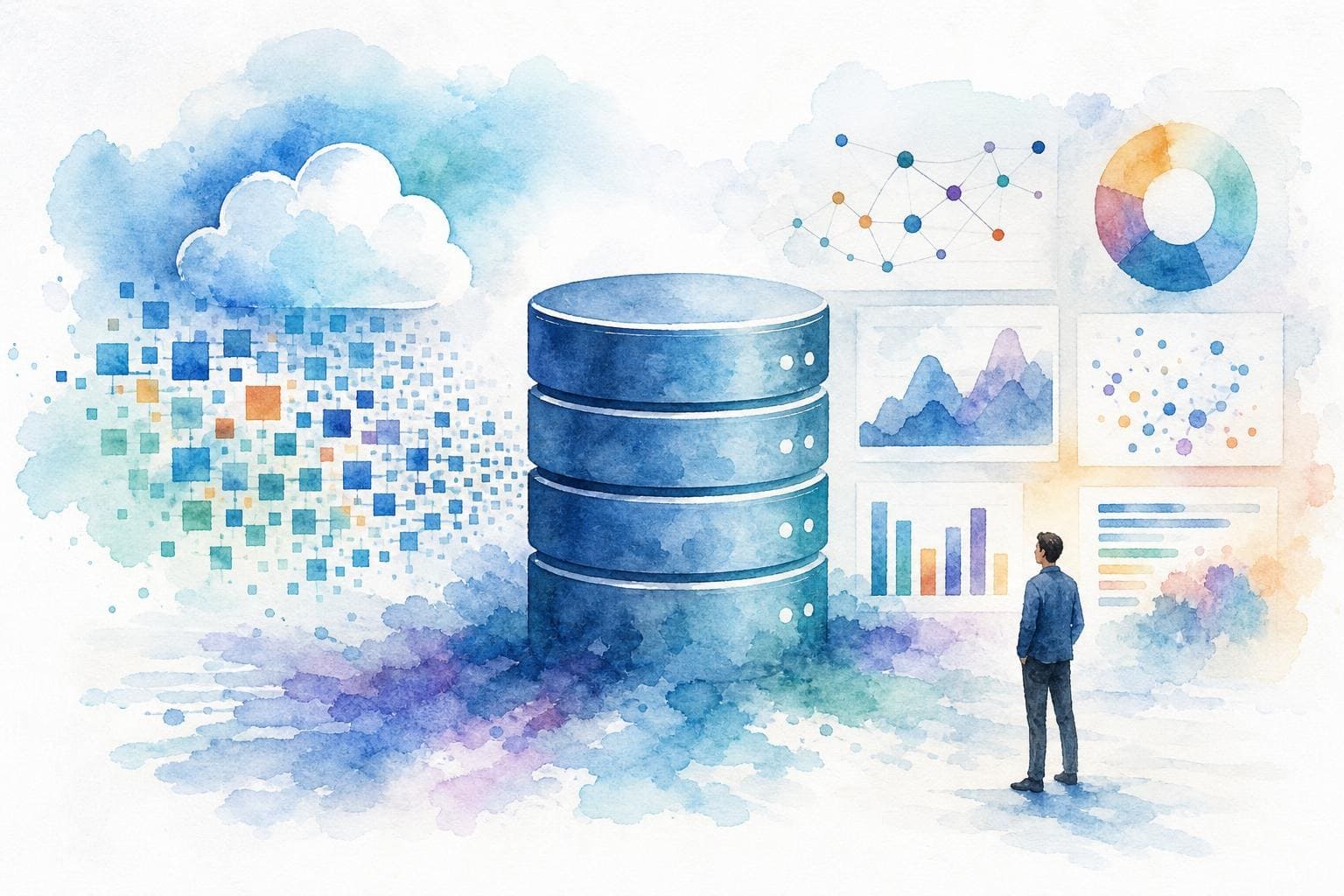
The term Big Data, translated into French as "données massives" (massive data) or "mégadonnées" (megadata), refers to datasets so large, so fast-moving, or so heterogeneous that traditional management tools can no longer process them effectively. A conventional relational database, designed for a few million well-structured rows, reaches its limits when faced with continuous streams of text, images, videos, and sensor signals. Big Data is therefore not just a matter of size: it represents a change in scale that requires new methods.
The term gained traction in the early 2000s, driven by the explosion of the Internet and search engines. In 2001, analyst Doug Laney formalized an initial framework around three dimensions, which later became the famous "3Vs." Web giants, faced with the challenge of indexing billions of pages, subsequently published foundational work on distributed storage and computing. These publications directly inspired the open-source tools that democratized the processing of massive data.
To answer the question "What is Big Data?" simply, we can identify three inseparable elements:
- A data reservoir: raw information from multiple, often unstructured sources.
- A set of technologies: architectures capable of storing and computing across multiple machines in parallel.
- An analytical approach: statistical and algorithmic methods that transform this data into useful knowledge.
This definition shows that Big Data is as much about organization as it is about computing. A company that accumulates terabytes without an exploitation strategy is not doing Big Data: it is merely storing costly archives. The real breakthrough occurs when data drives decision-making.
The fundamental pillars: understanding the 5Vs
To characterize a massive data project, specialists rely on a now-classic model: the 5Vs. Initially limited to three dimensions, this framework has expanded as companies realized that quantity alone was not enough. Today, it provides a useful lens for assessing a project’s maturity and anticipating its challenges.
Volume, Velocity, and Variety: the historical foundation
Volume refers to the mass of information to be processed. Where a small business once handled a few gigabytes, a telecommunications operator or retail network now manages petabytes. This growth stems from the proliferation of connected devices, digital platforms, and the digitization of administrative processes.
Velocity describes the speed at which data is generated and must be exploited. A bank detecting fraudulent transactions has milliseconds to react, not days. An electricity grid manager must continuously adjust the balance between production and consumption.
Variety highlights the diversity of formats. Structured data, organized in tables, coexists with emails, voice recordings, photographs, and connection logs. This heterogeneity significantly complicates analysis and requires tools capable of reading multiple formats simultaneously.
Veracity and Value: the importance of data quality
Veracity concerns the reliability of information. Duplicates in a customer file, poorly calibrated sensors, or erroneous entries distort even the most sophisticated analyses. The principle is well-known to specialists: poor-quality data produces poor-quality conclusions.
Value is the ultimate pillar. Collecting, cleaning, and storing data incurs real financial and environmental costs. We advocate for an approach based on quality rather than accumulation: a small, clean, and relevant dataset is better than a gigantic warehouse from which no one learns anything. This sobriety meets both economic and environmental responsibilities.
The technological infrastructure for processing massive data
No single computer, however powerful, can handle the volumes typical of Big Data on its own. The technical solution is based on a simple principle: distributing storage and processing across a large number of ordinary machines working together. This distributed approach has profoundly changed the architecture of information systems.
Distributed storage with Hadoop and Data Lakes
Emerging in the mid-2000s under the auspices of the Apache Foundation, Hadoop marked a turning point. This open-source software framework splits files into blocks distributed across multiple servers and duplicates each block to ensure availability in case of failure. Its MapReduce computing model sends processing tasks to where the data resides, rather than moving enormous volumes across the network.
Building on this approach, the concept of the Data Lake has become widespread. Unlike traditional data warehouses, which require prior structuring, the lake accepts information in its raw format. Analysts then organize it according to their needs. This flexibility carries a well-identified risk: without rigorous governance, the lake can turn into a "data swamp," where no one can find or understand the stored information.
Real-time processing and Cloud Computing
Hadoop excels at batch processing but struggles to meet real-time needs. Tools like Apache Spark (which computes in RAM) or Apache Kafka (specialized in managing continuous streams) have taken over for real-time applications. They enable, for example, analyzing road traffic as it evolves or recommending a product while a user browses a site.
Cloud Computing has since made these technologies accessible without heavy hardware investments. A Lyon-based startup can rent on-demand computing power that it could never have afforded on its own. However, this convenience raises a major sovereignty issue: where is the data hosted, and which laws govern it? Using European providers and open-source solutions, in our view, offers a credible way to retain control over this strategic asset.
The impact of Big Data on corporate strategy
The exploitation of massive data has shifted the center of gravity for many decisions. Where intuition and experience once dominated, leaders now have access to fine-grained, up-to-date, and often predictive indicators. This shift affects all business functions, from marketing to logistics to human resources.
Improving customer experience and personalization
Streaming video and music platforms perfectly illustrate this evolution. By analyzing a user’s listening or viewing history, they offer personalized recommendations. French retailers apply the same logic with loyalty cards: discount coupons are no longer identical for everyone but tailored to each household’s purchasing habits.
Personalization goes beyond simple recommendations. An insurer can adapt its offers, a transportation company can anticipate delays and notify travelers, and a bank can detect early signs of a customer about to switch to a competitor. However, this analytical precision requires a delicate balance. Overly intrusive personalization breeds mistrust, and customer trust remains a far more valuable asset than any algorithm.
Operational optimization and predictive maintenance
In industry, Big Data is transforming equipment management. Sensors installed on engines, turbines, or trains continuously measure temperature, vibrations, and pressure. By comparing these readings with historical failure data, algorithms detect anomalies before they cause a shutdown.
The benefits of predictive maintenance are concrete:
- Reduction of unplanned downtime: interventions are scheduled before failure occurs.
- Extended lifespan: parts are replaced at the right time, neither too early nor too late.
- Cost reduction: spare parts inventories are better managed.
- Enhanced safety: serious incidents are anticipated, particularly in transportation and energy.
Logistics also benefits from these advances. Optimizing delivery routes based on traffic, weather, and order volumes reduces both delays and fuel consumption.
New professions and the data-driven culture
The rise of massive data has given birth to a family of professions that did not exist twenty years ago. Engineering schools, universities, and continuing education programs have had to adapt their curricula to meet strong employer demand. These roles are distinguished by their complementarity: no single profile covers the entire value chain.
Among the most sought-after functions, we can cite:
- Data Engineer: designs and maintains the infrastructure that collects, transports, and stores data.
- Data Scientist: builds statistical and machine learning models to extract trends and make predictions.
- Data Analyst: translates results into dashboards and recommendations understandable by business teams.
- Chief Data Officer: defines the organization’s data strategy and ensures its governance.
- Data Protection Officer: ensures regulatory compliance, mandatory in many cases since the implementation of the GDPR.
However, recruiting experts is not enough. The success of a project depends on a true data-driven culture, shared at all levels. A sales director who can read an indicator, a technician who understands the importance of accurately entering information, a lawyer capable of dialoguing with an engineer: these are the conditions for sustainable transformation.
This acculturation requires training but also transparency. When employees understand how data is used and what it is for, they become active contributors rather than passive providers of information. We deeply believe in this collective dimension: data is a shared resource built together.
Ethical challenges, security, and privacy protection
The power of Big Data has a dark side that cannot be ignored. Cross-referencing seemingly innocuous information can sometimes reconstruct intimate details: health status, political opinions, sexual orientation, or financial situation. Several high-profile scandals, linked to the abusive exploitation of social media profiles, have shown that the line between analysis and manipulation can be crossed.
Algorithmic biases represent another major risk. A model trained on historical data reproduces, or even amplifies, the discriminations contained within it. A recruitment tool fed by decades of unequal practices may exclude certain profiles without anyone noticing. The organization’s responsibility is then fully engaged.
Security is also a constant concern. Concentrating vast amounts of information in a single system creates an attractive target for cybercriminals. French hospitals and local authorities have painfully experienced this during ransomware attacks that paralyzed their services.
GDPR compliance and data governance
Implemented on May 25, 2018, the General Data Protection Regulation (GDPR) has profoundly changed practices in Europe. It imposes several structuring principles:
- Lawfulness: any processing must be based on a legal basis, such as consent or legitimate interest.
- Minimization: only strictly necessary data can be collected.
- Limitation of retention: information cannot be kept indefinitely.
- Rights of individuals: access, rectification, erasure, and portability must be guaranteed.
Fines can reach 4% of global annual turnover, and the CNIL (France’s data protection authority) actively monitors compliance. Beyond the constraint, we see this framework as an opportunity: clear governance, defined responsibilities, and full traceability strengthen customer and partner trust.
The future of Big Data: Artificial Intelligence and Edge Computing
The link between massive data and artificial intelligence (AI) has become inseparable. The large language models that are transforming our relationship with digital technology were trained on corpora containing trillions of words. Without the infrastructures and methods born of Big Data, these systems would never have emerged. In return, AI enables the exploitation of previously unusable data, such as scanned documents, conversations, or medical images.
However, this convergence raises a critical question for Europe. If the models and the data that feed them remain concentrated in the hands of a few non-European actors, our strategic autonomy will be weakened. The development of open models, trained on transparent and respectful corpora of European languages, is a response we strongly support. The question "What is Big Data?" thus becomes inseparable from another: who owns the data that shapes tomorrow’s intelligence?
Edge Computing embodies the second major trend. Instead of sending all information to distant data centers, it processes data as close as possible to its source: in a car, a factory, or a medical device. This approach reduces latency, lightens network traffic, and limits the exposure of sensitive data. It also promotes more sustainable computing, better adapted to environments with limited resources.
The coming years will likely see three complementary movements:
- Frugality: more compact models capable of functioning without gigantic server farms.
- Decentralization: processing distributed between the cloud and terminals.
- Openness: tools and datasets shared as digital commons.
Big Data is therefore neither a passing trend nor merely a matter of servers. From the 5Vs to distributed architectures, from predictive maintenance to personalization, it has transformed how organizations understand their environment and make decisions. Its power comes with strong requirements: data quality, respect for privacy, bias mitigation, and control of environmental impact.
For European businesses and institutions, the challenge goes beyond technical performance. It involves choosing transparent infrastructures, open-source tools, and sovereign hosting to preserve control over this collective asset. The most valuable data is not the most abundant: it is the data we understand, protect, and exploit responsibly. Make this requirement the starting point of your own data strategy.

